A message from the founder · August 2026
Climate-health collaborations and the Second Symposium on Solar Radiation Modification
Dr. Ye Tao
Founder and Science Director
Dear Friends and Supporters,
Over the past month, MEER has continued to build momentum across both our international research programs and our global partnerships. It has been encouraging to see growing recognition that practical solutions to extreme heat are becoming an increasingly important part of the global climate conversation.
In Sierra Leone, we have taken an important step towards what could become one of our most significant climate-health research collaborations to date. Discussions have now begun with the international health organization Solthis on a joint project at the new maternity ward at Tombo Community Health Center. The proposed collaboration would combine the deployment of MEER's latest passive cooling materials with a comprehensive scientific monitoring program, allowing us to evaluate their performance within a functioning healthcare facility while studying the impacts of heat on healthcare workers, mothers, and newborn babies.
Projects such as these are particularly valuable because they allow us to move beyond laboratory testing and demonstrate how passive cooling technologies can improve real-world environments while generating robust scientific evidence. As temperatures continue to rise across many parts of Africa, we believe this work has the potential to contribute to more climate-resilient healthcare infrastructure and inform future adaptation strategies.
During July, I also traveled to Xi'an, China, to participate in the Second International Symposium on Solar Radiation Modification. The conference brought together leading scientists, engineers and policymakers from around the world to discuss climate intervention research, adaptation technologies and future directions for international collaboration. It was an excellent opportunity to highlight MEER's work, particularly our growing body of field research in Africa and our efforts to develop practical, scalable cooling solutions for communities already experiencing the impacts of extreme heat.
One of the highlights of the symposium was the opportunity to meet Professor Benjamin Sovacool, whose work on energy transitions and climate policy has helped shape international thinking in these fields. Our discussions reflected the growing interest in practical climate adaptation technologies and the important role that surface-based cooling solutions may play alongside broader climate strategies.
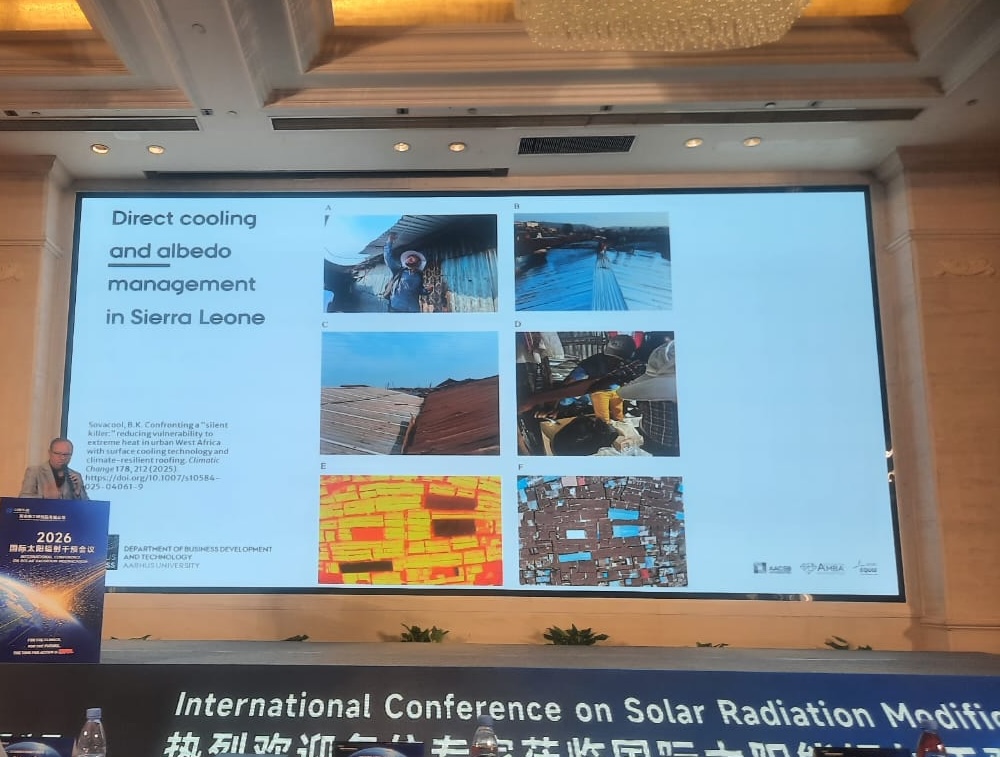
Beyond the conference itself, I have remained in China as we continue expanding MEER's scientific and technical capabilities. We are currently exploring opportunities to establish new engineering facilities, strengthen our technical teams, and accelerate the development and testing of our next generation of passive cooling materials. These investments will play an important role in moving new ideas from research into practical deployment.
We are also beginning discussions with colleagues in China about establishing a broader scientific alliance that would bring together universities, research institutes and technical organizations working on heat adaptation, surface cooling and related climate technologies. Building stronger international partnerships will be essential if we are to accelerate research, share knowledge and develop practical solutions at the scale that climate change increasingly demands.
What continues to encourage me most is the growing recognition that addressing climate change requires both mitigation and adaptation. While reducing greenhouse gas emissions remains essential, we must also develop practical ways to cool our communities and protect people from the heat that is already affecting lives today. At MEER, our mission is to advance surface-based cooling technologies that not only help societies adapt to rising temperatures but also contribute to cooling the planet itself by reflecting more solar energy back into space. Through our work in Africa, our expanding technical activities in China and our growing international collaborations, we remain committed to producing rigorous science that delivers practical, scalable solutions with measurable environmental and societal impact.
Your continued support makes this work possible. Every new partnership, every field study and every scientific collaboration strengthens our ability to develop solutions that can protect vulnerable communities while contributing to a cooler, more resilient future.
Thank you for being part of our journey. We look forward to sharing further progress with you in the months ahead.
Warm regards,
Dr. Ye Tao
Founder and Science Director
MEER – Mirrors for Earth's Energy Rebalancing