A message from the founder · September 2026
Advancing the science behind surface cooling
Dr. Ye Tao
Founder and Science Director
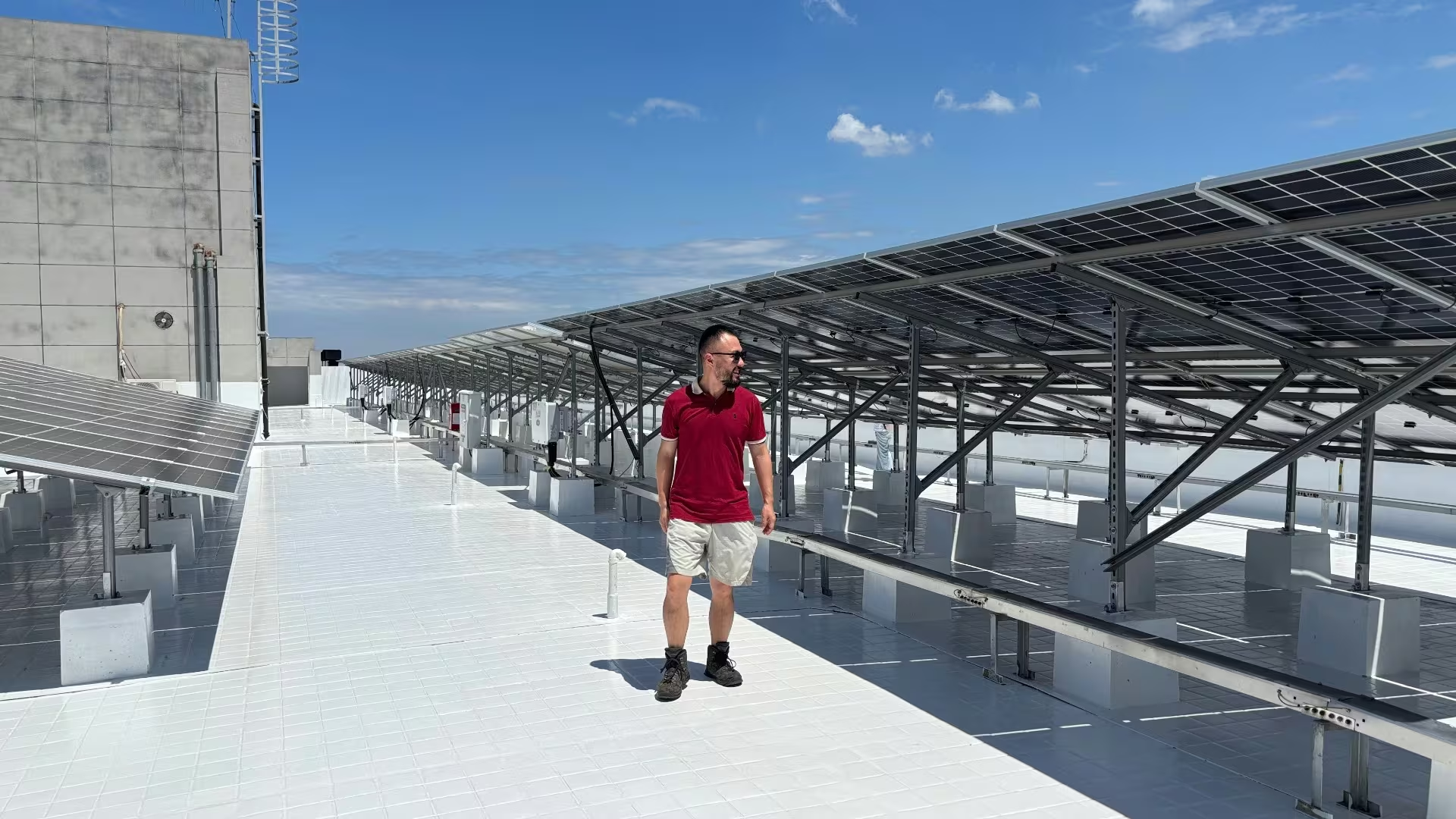
Dear Friends and Supporters,
During the past month, I have remained in China as we continue strengthening MEER's scientific and technical capabilities. A major focus of this work has been laying the foundations for our new technical program, including the establishment of an expanded engineering and materials research team that will support the development, testing and refinement of our next generation of passive cooling technologies.
Building this capability is an important milestone for MEER. Alongside our field research in Africa, it will allow us to accelerate the development of lower-cost reflective materials, improve manufacturing techniques and undertake the engineering research needed to move promising ideas from the laboratory towards practical, large-scale deployment.
Over the coming month, I will also be attending another scientific conference in China, providing further opportunities to exchange ideas with researchers working across climate science, engineering and adaptation. We are also exploring opportunities to visit research groups elsewhere in Asia that are investigating agricultural adaptation to rising temperatures. Understanding how passive cooling technologies may contribute to protecting agricultural productivity and improving resilience under increasingly extreme heat is an area that we believe holds considerable long-term potential.
Alongside these activities, we continue to advance an important area of scientific research that underpins much of MEER's work. One of our objectives is to improve how the cooling benefits of reflective surfaces can be measured and quantified. As interest in passive cooling technologies grows around the world, there is an increasing need for robust scientific methods that allow researchers to evaluate and compare their performance consistently under different environmental conditions.
Developing this framework will help strengthen the scientific foundations of surface cooling research, support future international collaboration and contribute to a better understanding of how reflective interventions influence the Earth's surface energy balance. While this work is technically challenging, it represents an important step towards ensuring that passive cooling technologies can be assessed using rigorous, transparent and internationally credible methodologies.
What continues to encourage me most is the growing recognition that climate adaptation must become a central pillar of our global response to climate change. Communities around the world are already experiencing more frequent and intense heatwaves, placing increasing pressure on public health, infrastructure, agriculture and livelihoods. Practical solutions that can reduce heat exposure today will become increasingly important alongside efforts to reduce greenhouse gas emissions over the coming decades.
At MEER, we remain committed to developing practical, affordable and scientifically rigorous cooling technologies that can help vulnerable communities adapt to rising temperatures while contributing to broader climate resilience. Every new collaboration, every engineering breakthrough and every scientific advance brings us one step closer to achieving that goal.
Thank you for your continued support and for being part of this journey. We look forward to sharing further progress with you in the months ahead.
Warm regards,
Dr. Ye Tao
Founder and Science Director
MEER – Mirrors for Earth's Energy Rebalancing